Vascular Surgery · Under Peer Review · 2026
Six Outcomes, One Stable Answer
The Scenario
Two surgical approaches to the same condition, six outcomes to compare them on, and heterogeneity above 80 percent on the outcomes that mattered most.
This one is still under peer review, so the condition and interventions stay masked here. What I can show is the part that made it work: a sensitivity framework built to find out whether the pooled answers were real or the property of one or two studies.
From Question to Answer
Clinical question
Between two approaches, which carries less harm across six binary outcomes?
The evidence
Comparative observational studies across multiple countries, some outcomes wildly heterogeneous
The design
Random-effects models wrapped in a four-layer sensitivity framework
The answer
Pooled estimates whose stability is demonstrated, not assumed; manuscript under review
The Decisions That Mattered
Hartung-Knapp intervals on every outcome.
With modest study counts, the conventional intervals are too confident. Hartung-Knapp pays the honesty tax up front.
Leave-one-out refits for all six outcomes.
Each pooled estimate was recomputed dropping every study in turn. If a conclusion dies when one study leaves, that is worth knowing before a reviewer finds it.
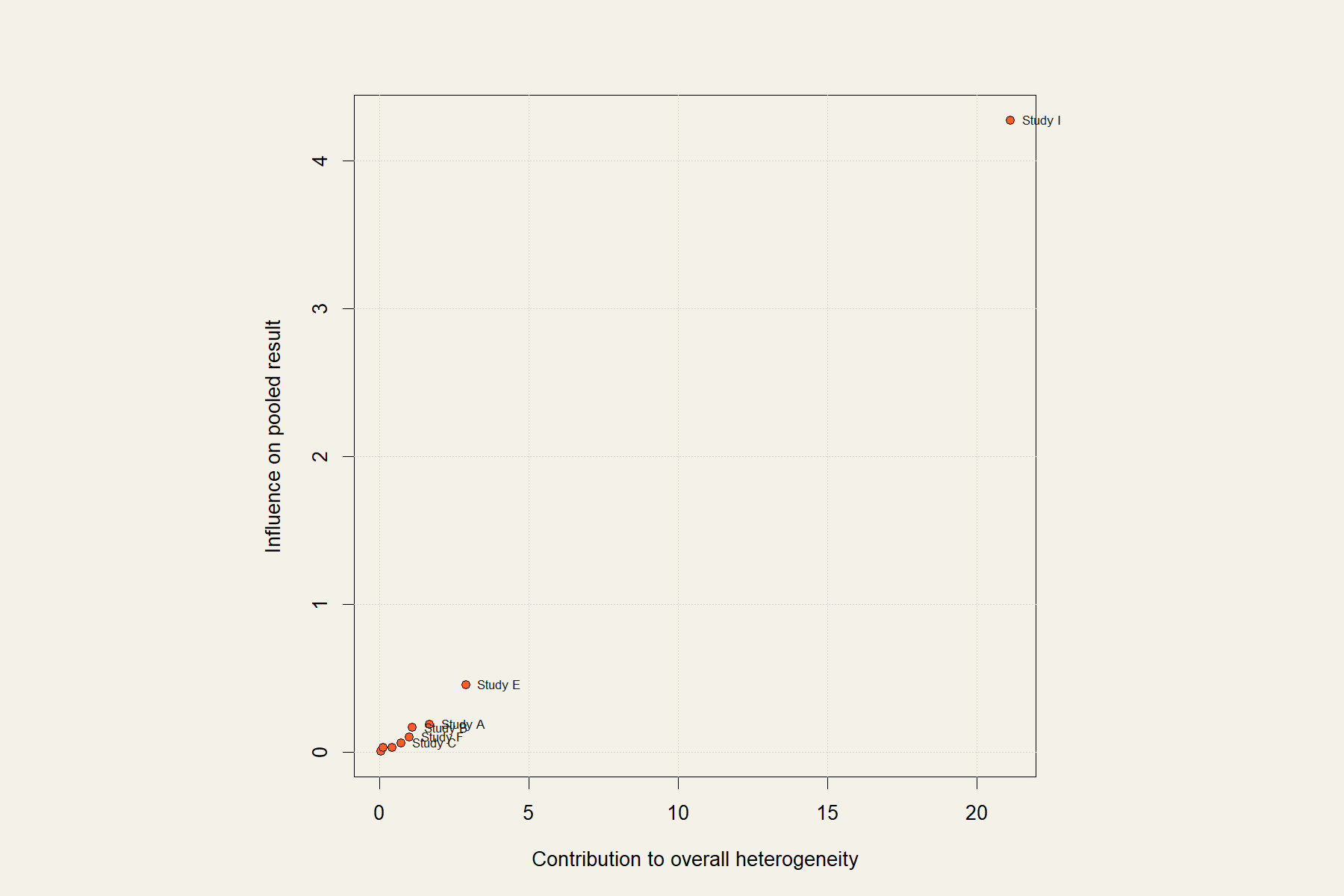
Baujat plots to name the heterogeneity.
When I-squared passes 80 percent, the useful question is which studies are responsible. The Baujat plot points at them directly.
Country subgroups with formal interaction tests.
Practice differs across health systems. Subgrouping with an interaction test checks whether geography explains the disagreement or just relabels it.
Overview
Problem
Six binary outcomes comparing two surgical approaches, with extreme heterogeneity on the ones that mattered.
Approach
DerSimonian-Laird random effects with Hartung-Knapp, leave-one-out, Baujat influence, and country subgroups.
Outcome
Under peer review. The framework, six outcomes each carrying their own stability evidence, is the part this page exists to show.
Figures
Reproducible R Code
The stability framework
# Random effects with Hartung-Knapp, per outcome
m <- metabin(event.e, n.e, event.c, n.c,
             studlab = study, sm = "OR",
             method.tau = "DL",
             method.random.ci = "HK",
             incr = 0.5, allstudies = TRUE)

metainf(m)          # leave-one-out stability
baujat(m)           # who drives the heterogeneity?

# Subgroups with an interaction test
m_geo <- update(m, subgroup = country)
m_geo$pval.Q.b.random   # does geography explain it?