Anonymized Clinical Field · In Preparation · 2026
The Network That Wasn't Connected
The Scenario
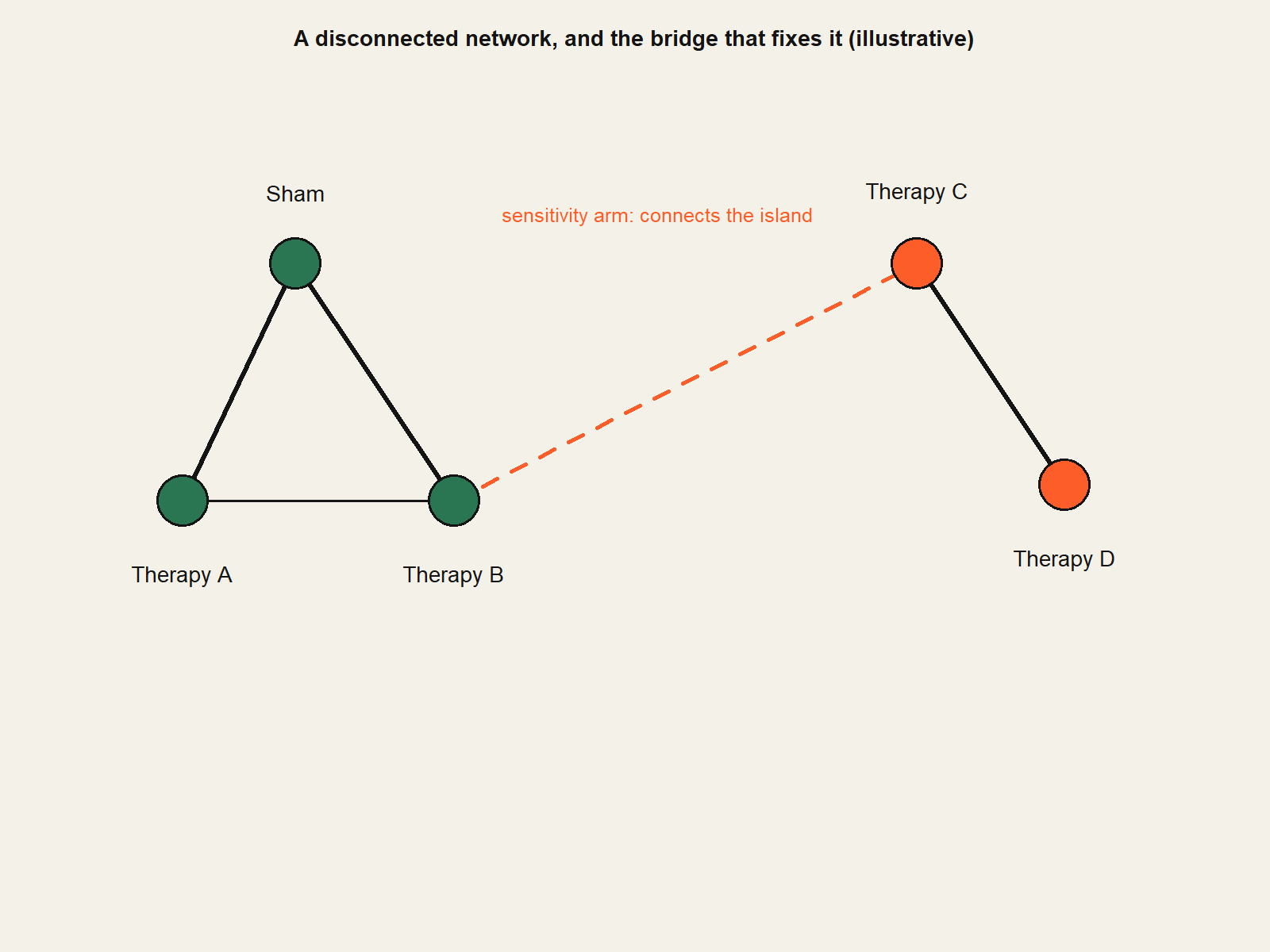
The treatments existed. The comparisons didn't. Half the evidence network floated as an island that no path from the reference arm could reach.
A network meta-analysis assumes you can walk from any treatment to any other through shared comparisons. This evidence base broke that assumption, and the project is unpublished, so the treatments stay masked. The repair strategy is the story.
From Question to Answer
Clinical question
Rank several therapies for one condition when few were ever trialed head to head
The evidence
A sparse set of trials forming two disconnected islands, plus medians where means were needed
The design
Component-wise analysis, pairwise pooling for the islands, and one carefully justified bridge
The answer
A defensible ranking within each component, with the bridge tested as a sensitivity, not assumed as fact
The Decisions That Mattered
Analyze the components separately instead of forcing one network.
Pretending a disconnected network is connected produces estimates with no evidential path behind them. Each component was analyzed as its own network, and the gap was reported as a finding.
Island comparisons pooled pairwise with Hartung-Knapp.
Comparisons stranded outside any loop still carry information. They were pooled as conventional pairwise meta-analyses with small-sample-honest intervals.
One sensitivity arm that creates the network's only loop.
A single additional arm, digitized from a published figure, connected the islands and made between-study variance estimable at all, with exactly one degree of freedom. It ran as a labeled sensitivity analysis, never as the primary.
Wan conversions for studies reporting medians.
Trials reporting median and IQR instead of mean and SD were converted with the Wan formulas, with source values kept inline so every converted number can be traced.
Overview
Problem
A treatment-ranking question sitting on a network that graph theory says cannot be analyzed as one.
Approach
Component-wise netmeta, Hartung-Knapp pairwise pooling for stranded comparisons, and a single justified bridging sensitivity.
Outcome
Manuscript in preparation; clinical details masked until submission. The judgment call is the showcase: a fragmented network reported honestly.
Figures
Reproducible R Code
Diagnose, then design
# Diagnose the geometry before modeling anything
nc <- netconnection(treat1, treat2, studlab, data = pw)
nc$n.subnets                 # more than 1 means: stop, redesign

# Main analysis: each component on its own
net1 <- netmeta(subset(pw, component == 1), random = TRUE)
net2 <- netmeta(subset(pw, component == 2), random = TRUE)

# Islands: honest pairwise pooling
m_isl <- metacont(n.e, mean.e, sd.e, n.c, mean.c, sd.c,
                  studlab = study, sm = "SMD",
                  method.random.ci = "HK")

# The bridge runs once, labeled, as sensitivity only.