Thoracic Oncology · J Clin Oncol (ASCO 2026) · 2026
Radiation or Surgery for Early Lung Cancer?
The Scenario
Stereotactic radiation or surgery for early-stage lung cancer. Patients ask it plainly; the literature answers it messily.
Direct trials are scarce, and observational comparisons are confounded by who gets offered surgery in the first place. I restricted the evidence to propensity-matched comparisons and rebuilt the missing statistics myself when papers did not report them.
From Question to Answer
Clinical question
For operable early NSCLC, does SBRT match surgery on survival and disease control?
The evidence
Dozens of comparative studies, many without a usable hazard ratio
The design
Propensity-matched restriction, HR reconstruction from event counts, meta-regression on the differences
The answer
A pooled comparison across survival and control endpoints, presented at ASCO 2026
The Decisions That Mattered
Only propensity-matched comparisons entered the pool.
Unmatched cohorts compare healthier surgical patients with sicker radiation patients. Matching at the study level is the closest observational data gets to a fair contest.
Hazard ratios reconstructed with the Parmar-Tierney method when unreported.
Many papers give event counts and totals but no HR. Deriving the log HR and its standard error from what they do report keeps those studies in the evidence instead of discarding them.
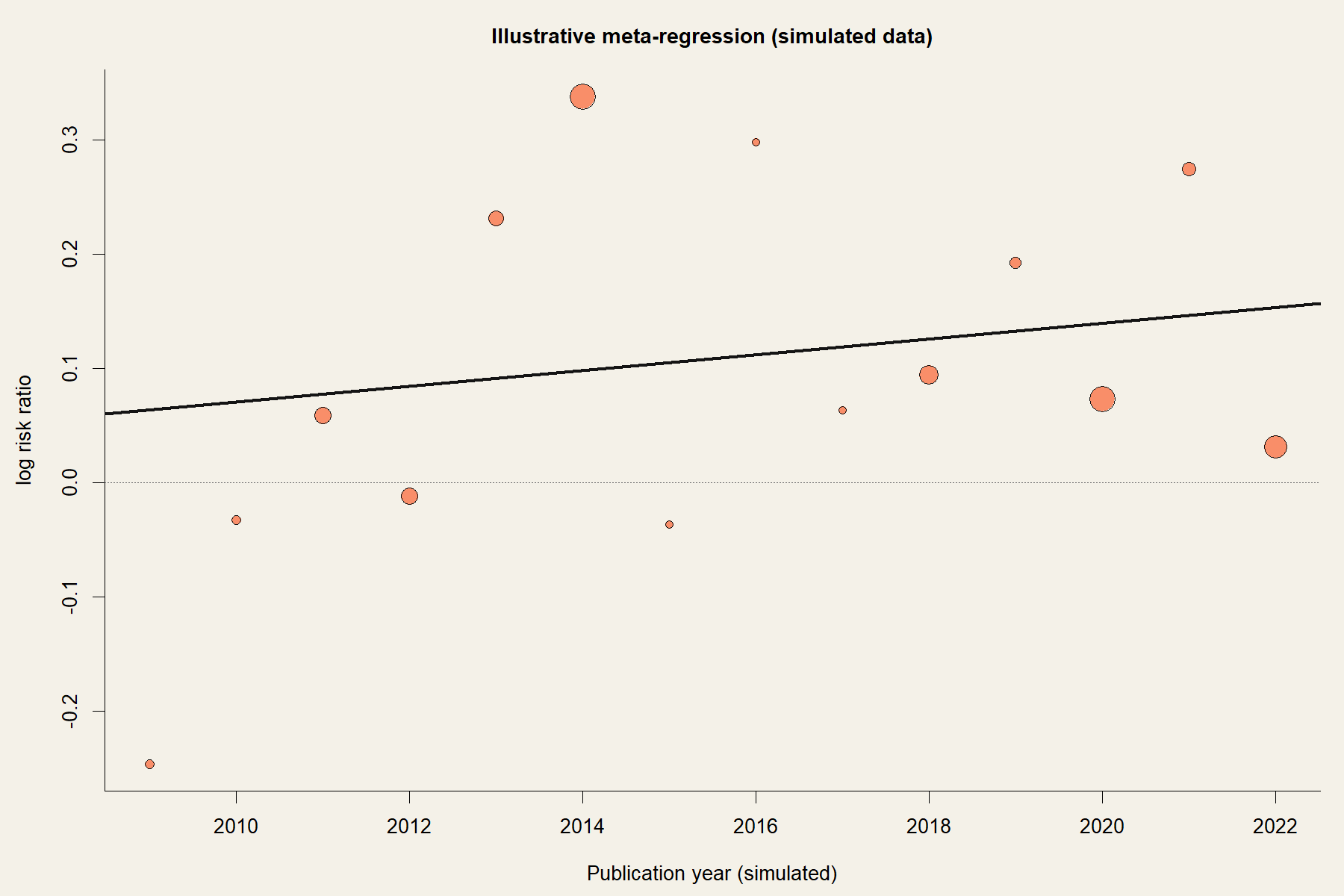
Meta-regression instead of shrugging at heterogeneity.
When effects differ across studies, the interesting question is why. Regressing the effect on study-level characteristics turns heterogeneity from a nuisance into a finding.
Explicit zero-event handling in the reconstruction.
Arms with no events break naive formulas. The reconstruction returns a safe missing value rather than a fabricated number, and the analysis records which studies that affected.
Overview
Problem
No trials settle SBRT versus surgery in operable early NSCLC, and observational reports often omit the statistics needed for pooling.
Approach
Propensity-matched restriction, Parmar-Tierney hazard-ratio reconstruction, random-effects pooling, and meta-regression.
Outcome
Presented at the ASCO 2026 Annual Meeting and published in the Journal of Clinical Oncology supplement, first author.
Figures
Reproducible R Code
HR reconstruction and meta-regression
# When a study reports events and totals but no HR:
# Parmar/Tierney reconstruction of logHR and its SE
estimate_HR_from_events <- function(e1, n1, e2, n2) {
  if (e1 == 0 || e2 == 0) return(c(NA, NA))  # safe, logged, not faked
  logHR <- log((e1 / n1) / (e2 / n2))
  seHR  <- sqrt(1 / e1 + 1 / e2)
  c(logHR, seHR)
}

# Pool, then ask WHY effects differ
dat <- escalc(measure = "RR", ai = e1, n1i = n1,
              ci = e2, n2i = n2, data = studies)
rma(yi, vi, data = dat)                    # pooled effect
rma(yi, vi, mods = ~ year + median_age,    # meta-regression
    data = dat)
Publication
View on ResearchGate
Read publication ↗