Stroke Neurology · J Clinical Neurology · 2026
Cerebrolysin and the Bleeding Question
The Scenario
Some stroke teams add cerebrolysin after reperfusion therapy. The safety worry is bleeding into the brain.
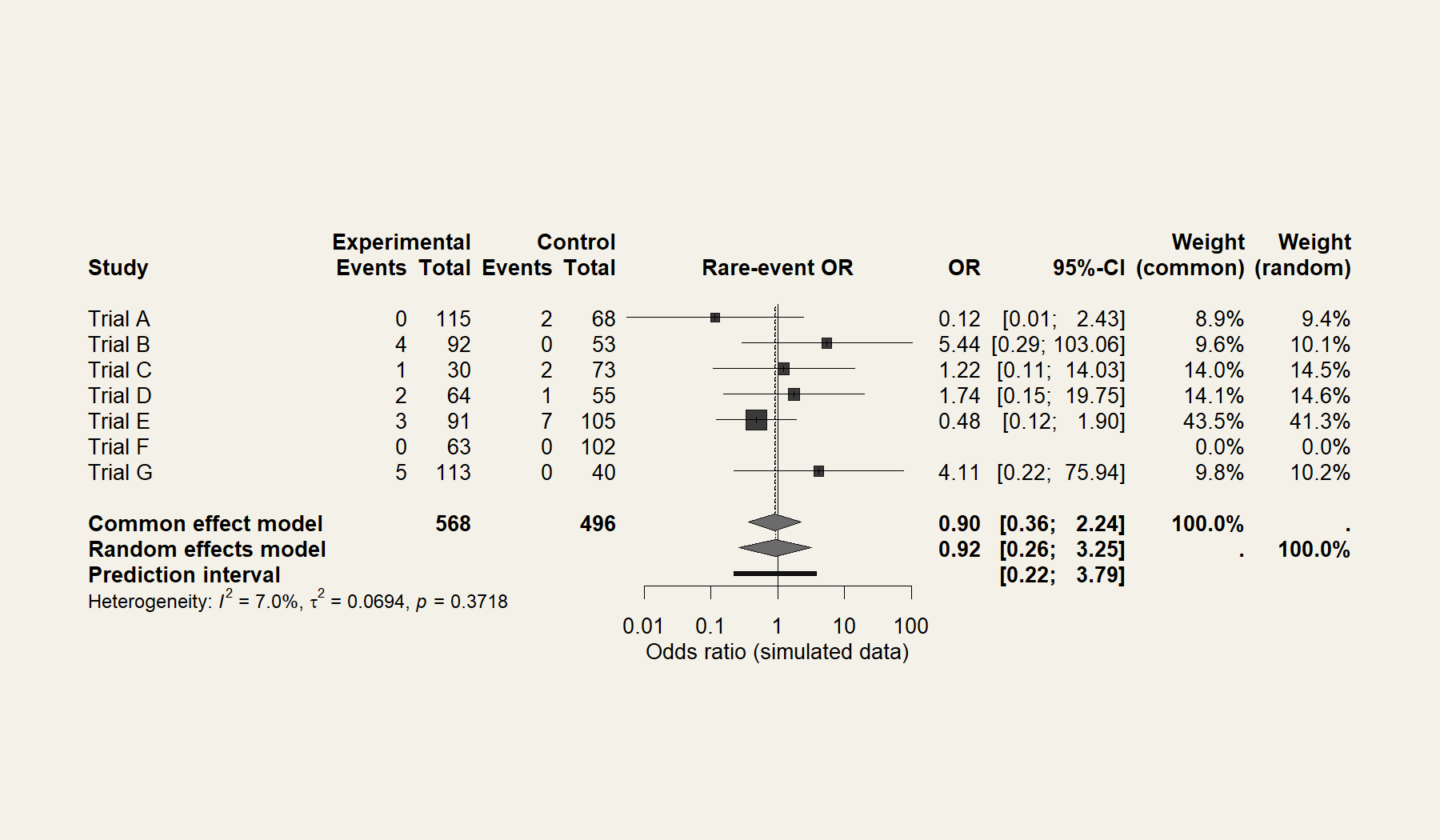
Hemorrhagic transformation is uncommon. That is good news for patients and bad news for statistics: with a handful of events per trial, a default random-effects model gives an answer that looks precise and is not. This analysis was built around that constraint.
From Question to Answer
Clinical question
Does adjunct cerebrolysin raise the risk of hemorrhagic transformation?
The evidence
A small set of trials, each with very few bleeding events
The design
Estimators chosen for sparse binary data, tested against each other
The answer
A pooled estimate the sparse data can actually support, published and citable
The Decisions That Mattered
Hartung-Knapp intervals instead of the classic Wald-type CI.
With few trials, conventional intervals are too narrow. Hartung-Knapp widens them honestly.
Peto odds ratios as the rare-event sensitivity model.
Peto needs no continuity correction, so zero-event arms enter the pool without artificial 0.5 additions that distort sparse data.
Leave-one-out on every outcome.
When one trial can carry half the events, you must know whether the conclusion survives without it. It did.
Trial sequential analysis on top of the pooled result.
A meta-analysis can be underpowered too. TSA asks whether the accumulated evidence has reached the information size the question needs, instead of assuming it has.
Overview
Problem
A rare but serious harm signal that default pooling methods handle badly.
Approach
Hartung-Knapp random effects, Peto rare-event sensitivity, leave-one-out, and trial sequential analysis.
Outcome
Published in the Journal of Clinical Neurology, March 2026. The safety conclusion did not depend on any single estimator or trial.
Figures
Reproducible R Code
Rare-event framework
# Primary model: random effects with Hartung-Knapp intervals
m_hk <- metabin(event.e, n.e, event.c, n.c,
                studlab = study, sm = "OR",
                method.tau = "REML",
                method.random.ci = "HK",
                prediction = TRUE)

# Rare-event sensitivity: Peto, no continuity correction
m_peto <- metabin(event.e, n.e, event.c, n.c,
                  studlab = study, sm = "OR",
                  method = "Peto")

# Stability: refit dropping each trial in turn
metainf(m_hk)

# Then trial sequential analysis on the cumulative evidence.
Publication
Read in JCN
Read publication ↗