Vascular Surgery · Ann Vasc Surg · 2026
Pooling the Unpoolable: Aorto-Esophageal Fistula
The Scenario
An aorto-esophageal fistula connects the body's largest artery to the swallowing tube. It is rare enough that the literature is mostly case reports, and case reports are exactly what standard meta-analysis cannot pool.
The clinical team needed mortality and reintervention estimates per management strategy: stent graft alone, staged repair, open surgery, palliation. The unit of evidence was often a single patient. So the model had to work at the patient level.
From Question to Answer
Clinical question
Which management strategy for this rare fistula carries survivable odds?
The evidence
Case reports and tiny series: patient-level counts with denominators of one
The design
A Bayesian one-stage hierarchical binomial model over case-level data, stratified by fistula morphology
The answer
Strategy-level probability estimates with honest uncertainty, published in Annals of Vascular Surgery
The Decisions That Mattered
A one-stage Bayesian binomial model instead of two-stage pooling.
Two-stage methods need per-study effect estimates, which single cases cannot give. Modeling the raw counts directly in brms lets every patient contribute without inventing within-study statistics.
Hard-stop denominator validation before fitting.
Hierarchical models shrink silently when denominators are wrong. The pipeline refuses to fit until every count reconciles against its source.
Stratification by fistula morphology.
Type I to type IV fistulas are different surgical problems. Pooling across them would have produced an average of nothing.
Provenance you can verify: a registered protocol and hash-stamped deliverables.
A PROSPERO protocol up front, and SHA256 checksums on the final dataset and outputs, so the analysis that was planned is provably the analysis that shipped.
Overview
Problem
A lethal, rare condition whose evidence base is case reports that conventional meta-analysis cannot use.
Approach
One-stage Bayesian hierarchical binomial modeling of case-level counts, stratified by morphology, with validated denominators.
Outcome
Published in Annals of Vascular Surgery, June 2026, PROSPERO-registered, with the full audit trail archived alongside the deliverables.
Figures
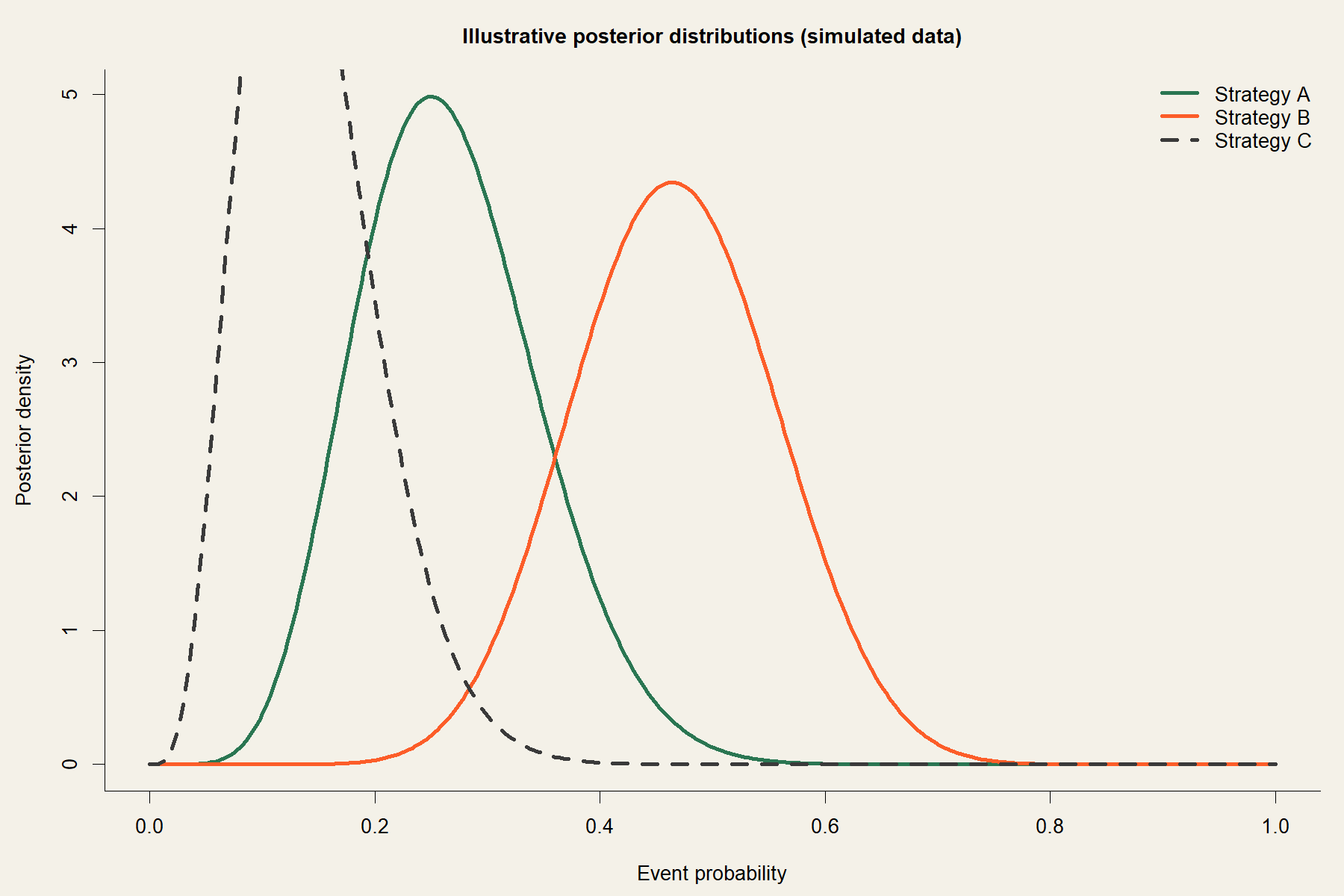
Reproducible R Code
One-stage Bayesian pooling
# One-stage: model patient-level counts directly
fit <- brm(events | trials(n) ~ 1 + (1 | study),
           family = binomial(),
           data = cases,            # validated denominators only
           chains = 4, cores = 4)

# Strategy-level posteriors
fit_strat <- brm(events | trials(n) ~ 0 + strategy + (1 | study),
                 family = binomial(), data = cases)
posterior_summary(fit_strat)   # medians + credible intervals
Publication
View on ResearchGate
Read publication ↗